
August 25, 2026
The Office in the AI Era Has a New Job
AI is quietly absorbing the 'desk work' your office was built for. Which leaves a sharper question for any leader: what are the days in actually for?

From January, employees can claim unfair dismissal after six months. A practical four-month probation guide, with a free timeline and FAQ.
Published Date:
November 22, 2026

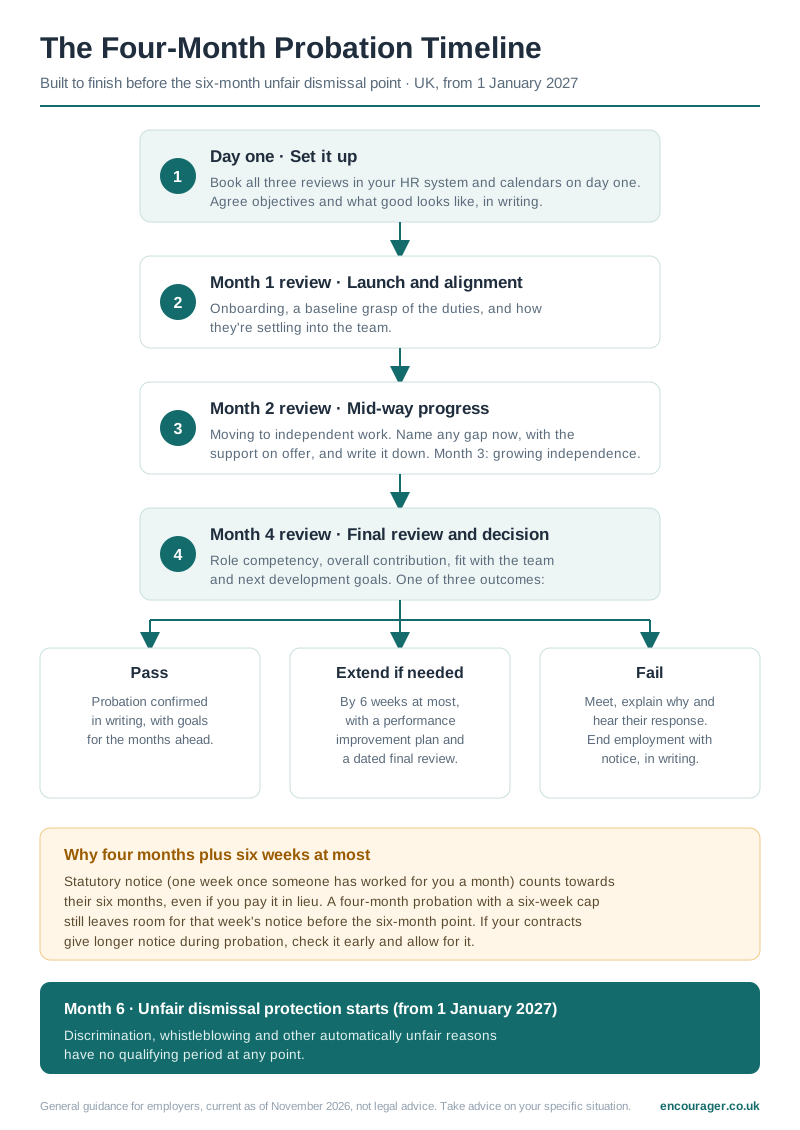
(There's a free four-month probation timeline and an FAQ at the end of this guide.)
Most probation processes in UK businesses were designed around a rule that ends on 31 December. From 1 January 2027, employees can claim unfair dismissal after six months in the job, not two years, and the cap on unfair dismissal compensation goes at the same time. (I've written about the wider Employment Rights Act changes separately.)
That changes what probation is for. Under the old rule, it was mostly a formality with a safety net behind it. If the probation date came and went and you still weren't sure, you had well over a year more to work it out. Most of the SMEs and PE-backed businesses I work with used every bit of it.
From January, the safety net goes. Probation stops being a polite ritual and becomes the main window you have to decide, fairly and on the record, whether someone is right for the role.
The probation periods I see most often are three months or six. Three months is usually fine. Six months used to feel generous, but from January it means your final review and the employee's new legal protection arrive in the same week.
The law also requires a little more time than people expect. If you end someone's employment and they're owed statutory notice (one week for anyone employed between one month and two years), that notice counts towards their length of service for unfair dismissal purposes, even if you pay them in lieu rather than have them work it. And that's only the legal minimum. Some contracts give more, and if someone works a longer notice period, all of it counts, because they're still employed. So it's worth checking what yours actually say. So with a six-month probation, a decision made in the final week can land on the wrong side of the line.
I once watched a business leave an awkward probation conversation until the last week. The manager was on holiday, then the finance director was, then month-end got in the way. Nothing dramatic, just ordinary diaries. Under the new rules, that kind of drift is the difference between a fair, straightforward exit and an employee with full unfair dismissal rights.
For most roles I'd now set probation at four months, with three reviews booked on the day someone starts. Put them in your HR system and in everyone's calendars on the start date, owned by the line manager or HR, so nobody has to remember.
The month-one review: launch and alignment. Is onboarding done, do they understand the core of the role, and how are they settling into the team?
The month-two review: mid-way progress. Are they moving from being shown to doing it themselves? This is the moment to name any gap, plainly and kindly, with the support on offer and a date to look at it again. Write it down and share it.
The month-four review: final performance and sign-off. Role competency, overall contribution, how they work with the team, and what they should be developing next. Then one of three outcomes. Pass, and confirm it in writing. Extend if you genuinely need more evidence, by six weeks at most and with a performance improvement plan. Or end their employment, with notice, after a fair conversation.
The six-week cap matters. Four months plus six weeks still leaves room for a week's notice before the six-month point. Go beyond that and you're back to racing the calendar. It's also the moment to check what notice your contracts give during probation. If it's longer than a week, you'll need to make the final decision earlier to allow for it.
Before you change anything, check what your contracts, offer letters and handbook say, and take advice before applying a new approach to people already in post. Discrimination, whistleblowing and the other automatically unfair reasons have never needed two years' service, and they still don't, so clear, fair notes at every review protect both sides.
The legal change is simple. The behaviour change isn't.
Most of the early-tenure problems I see aren't really about bad hires. They're about managers who don't yet know how to say "this isn't working yet" without it sounding like "you're on your way out". So they say nothing, hope it improves, and the window closes.
That's a skills problem, and it's fixable. A short session with your line managers on how to run each review, what to record and when to bring in HR will do more for you in 2027 than another policy document. It's a session I run for clients, and it's also where coaching earns its keep. The manager who can hold an honest, kind, specific conversation at the two-month review rarely needs the difficult one at four.
The six-month rule can look like a threat to employers. I'd read it the other way round. It makes businesses review new people properly, and act when it isn't working. That's better than what I see far too often: employers hanging on to someone who's struggling for years, because nobody dealt with it during probation and it felt too late to start. New people deserve an honest answer early. So do the businesses that hire them.
If you'd like a second pair of eyes on your probation process and contracts before January, my fixed-fee HR audit covers both. Or start with a 30-minute call. It costs nothing but the half hour.
General guidance for UK employers, not legal advice. The rules described here start on 1 January 2027; check the current position and take advice on your specific situation before acting.
Here's the whole process on one page.

Fractional HR, executive coaching and workforce transformation — designed for the Human + AI era.