
August 25, 2026
The Office in the AI Era Has a New Job
AI is quietly absorbing the 'desk work' your office was built for. Which leaves a sharper question for any leader: what are the days in actually for?

The redundancy consultation process, step by step - pools, criteria, the 20-employee threshold, and the 2026 rule changes that double the cost of getting it wrong.
Published Date:
August 6, 2026

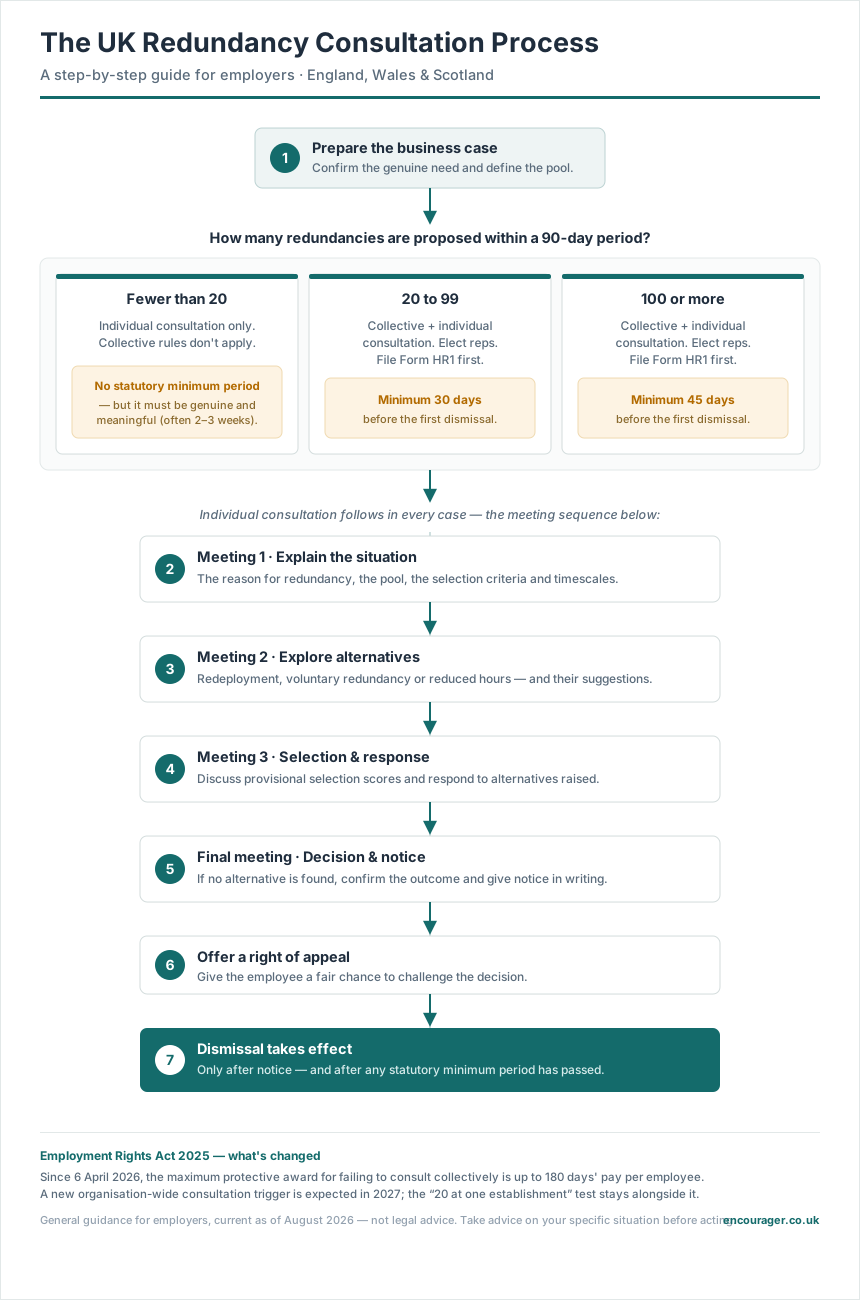
(there's a complete flowchart of the redundancy consultation process at the foot of this article, as well as an FAQ section)
You've made the decision. Nobody else knows yet - not your leadership team, not your co-founder. And now you're reading guides at eleven at night, because the decision was the easy part. What keeps you up is the doing of it: the redundancy consultation process, the letters, the meetings, the risk of getting something legally wrong while people you hired are sitting across the table from you.
I've run these processes many times, including working internally as HR Director, and now as a redundancy consultant alongside founders and SMEs who are doing it for the first time. The pattern is always the same. The commercial logic arrives quickly. The anxiety is about everything after.
So this is the process, step by step: legally, commercially, and humanly. Because a redundancy done properly protects all three.
Everything defensible about a redundancy is built before consultation starts.
A genuine business rationale. Redundancy is about the role, not the person. The work has reduced, the business is restructuring, a site is closing. If what you actually have is a performance problem or a personality clash, redundancy is the wrong tool, and tribunals are practised at spotting a redundancy that's really a dismissal wearing a coat.
The selection pool. Who is genuinely at risk? Just the one role, or everyone doing similar work? Employers get this wrong in both directions. A pool of one that should have been four, or a sprawling pool that drags people into anxiety unnecessarily. The pool needs a rationale you could explain out loud without wincing.
Fair, objective selection criteria. Skills, relevant experience, disciplinary record, measurable performance i.e. things you can evidence. Two classic traps: "attitude," which is unmeasurable and quietly becomes "people I like"; and last-in-first-out used on its own, which risks age discrimination and rewards tenure over capability. Criteria should be scored by more than one person, with evidence behind each score, because those scoresheets may one day be read aloud in a tribunal.
None of this is box-ticking. It's the difference between a decision and a defensible decision.
The rules change sharply at twenty.
If you're proposing fewer than 20 redundancies, you're in individual consultation territory with no fixed statutory timescale, but the consultation must still be genuine and meaningful (more on that below).
If you're proposing 20 or more redundancies at one establishment within 90 days, collective consultation rules apply. That means consulting with recognised trade union or elected employee representatives, and minimum periods before the first dismissal takes effect: 30 days for 20–99 proposed redundancies, 45 days for 100 or more. It also means notifying the Secretary of State on an HR1 form. This is the step busy leadership teams forget most often, and failing to file it is a criminal offence, not a paperwork slip.
And the risk calculus here has just changed. Under the Employment Rights Act 2025, the maximum protective award for failing to consult properly doubled in April 2026 - from 90 to 180 days' gross pay per affected employee. The Government's stated intent was to stop larger employers treating the award as a cost of doing business. For an SME, a failed collective process was already expensive; it's now potentially existential. If your restructure also involves changing terms rather than removing roles, be aware the Act's fire-and-rehire restrictions land in January 2027 - dismissing people for refusing changes to core terms will be automatically unfair in almost all circumstances. I've written about the wider Act separately; the short version is that the cost of a shortcut has gone up across the board.
"Meaningful" is doing a lot of work in employment law, and it means something specific: consultation happens while the outcome can still be influenced. If the decision about individuals is already final, you're not consulting. You're announcing slowly.
In practice, individual consultation usually means at least two or three meetings per person: one to explain the situation, the rationale, the pool and the criteria; one or more to hear their responses, challenges and alternatives; a final one to confirm the outcome. Let people be accompanied by a colleague or union rep. The strict legal right attaches to certain hearings, but allowing it throughout costs you nothing and signals good faith.
And take alternatives seriously, because a tribunal will ask whether you did. Redeployment into vacancies. Reduced hours. Voluntary redundancy. Pausing recruitment elsewhere. The test isn't whether you found an alternative. Often there isn't one, it's whether you genuinely looked.
Here's the gap I see most often: the process on paper says "considering alternatives" while the manager in the room has visibly already moved on. Employees can tell. Tribunals can tell. The consultation meeting where the manager reads from a script and can't answer a single question off it does more damage than the redundancy itself.
Once consultation genuinely concludes, the mechanics:
Statutory redundancy pay applies to employees with two or more years' service: half a week's pay per full year under 22, one week per year from 22 to 40, one and a half weeks per year at 41 and over - service capped at 20 years, weekly pay currently capped at £751, giving a statutory maximum of £22,530. Redundancy payments are tax-free up to £30,000. Check your contracts for enhanced schemes; if you've promised more, you owe more.
Notice is at least one week per year of service up to twelve weeks, or the contractual notice if longer. You can pay in lieu if the contract allows.
Settlement agreements sit alongside all this, not instead of it. Where the sums are larger, the circumstances more sensitive, or you want certainty against future claims, a settlement agreement with the employee taking independent legal advice, which you typically contribute towards, can be the cleaner route for both sides. It's a judgment call, not a default. Used well, it buys dignity and certainty. Used to paper over a broken process, it just gets expensive.
These figures change every April. Check gov.uk before you rely on them.
Rarely on the mechanics. Almost always on the sequencing and the sincerity.
The predetermined outcome that leaks. I've seen an internal email i.e. written weeks before consultation opened, or referring to someone's "exit date." Once that exists, no amount of process afterwards repairs it. Disclosure finds these things.
Sham scoring. Criteria reverse-engineered to produce a list that was already written. Scorers can usually feel it happening, and it corrodes them too. You've made your managers complicit in something they know isn't straight.
Announcing, then consulting. Telling the all-hands the restructure is "happening" before individual consultation begins. Commercially understandable, as you want to control the narrative, but legally corrosive, because you've just evidenced that the outcome wasn't open.
Doing it coldly. The process run entirely through HR letters, where nobody senior looks anyone in the eye. It might survive a tribunal. It won't survive the memory of the people who stay - and they were watching more closely than the people who left.
The reframe worth sitting with is this: the redundancy consultation process isn't bureaucratic friction between you and a decision you've already made. Done properly, it protects the people leaving with fairness, notice and money. And it protects the people staying, who are learning, in real time, what this organisation does to people when the numbers turn. Done badly, it poisons both. Plus your tribunal exposure, which is now at double the old ceiling.
Most founders I work with don't get this wrong through callousness. They get it wrong through speed, and through never having done it before.
If you're facing a restructure without senior HR support in the building, this is exactly the work I do: planning and running the process end to end, so it's done properly the first time. Have a look at Workforce Transformation and redundancy advice for employers, or book a discovery call (thirty minutes, no pitch, no obligation).
This article is general guidance for UK employers, not legal advice. Statutory figures are correct at the time of writing and change annually - always verify current rates on gov.uk, and take advice on your specific circumstances.

Fractional HR, executive coaching and workforce transformation — designed for the Human + AI era.

