
August 25, 2026
The Office in the AI Era Has a New Job
AI is quietly absorbing the 'desk work' your office was built for. Which leaves a sharper question for any leader: what are the days in actually for?

Motivational Interviewing is a powerful tool for empathic leaders. Learn how it can transform your conversations.
Published Date:
April 3, 2025

Have you ever been in a conversation where the person you are talking with is trying to 'fix' you?
It might be that you had a difficult decision to make, or perhaps wanted to explore options, or perhaps didn't know if you wanted to make a change in your career or professional development.
Instead of listening and giving you a chance to think things through, the person you're talking with jumps in with advice, and, even if well-meaning, they come out with patronising statements like 'why don't you just...', or "you should do this or that", or, "what you need to do is...".
Or perhaps you've tried to help one of your team members or colleagues to decide a way forward, but you've found yourself go into "advisor mode", very well meaning of course, but ultimately your efforts are not well received and you sense that the conversation is a waste of time?
If so, I'd highly recommend that you explore the art of Motivational Interviewing. But what is that, I hear you say!
When I first heard the term Motivational Interviewing, I assumed it was something to do with interviewing people for jobs. I've since learned it's a powerful tool in any leader's toolkit to become a more empathic leader that makes their team members and colleagues feel listened to and understood. It has the power to act as a catalyst for lasting change and progression in a person's life, role, or career.
Reflecting on insights from my recent workshop in April at Henley Business School's MSc in Coaching for Behavioural Change, I’ve included a few tips in the second half of this article, but first let's dive into what it is, and why you should consider using a few simple techniques to be a better manager, colleague, or friend. ⬇️
Motivational interviewing (MI) evolved from Carl Rogers' person-centred approach to counselling and therapy as a method to help people commit to the difficult process of change. It was introduced by psychologist William R. Miller in 1983 and further developed by Miller and psychologist Stephen Rollnick. “The more you try to insert information and advice into others, the more they tend to back off and resist. This was the original insight that generated our search for a more satisfying and effective approach,” Rollnick writes.
The approach contrasts with coercive or externally-driven methods of motivating change by not imposing it, but instead nurturing change in alignment with the individual's values and concerns. Motivational Interviewing helps a person: explore their ambivalence, think something through for themselves - and decide what’s best for them moving forward.
“People are generally better persuaded by the reasons which they themselves discovered, than by those which have been discovered by others”
Blaise Pascal, C17th French Mathematician / Philosopher
MI was originally validated as an evidence-based practice for treating individuals with substance use disorders, and has since been applied effectively to various other issues encountered in counselling and coaching settings. However, its applicability extends far beyond these settings; MI can effectively facilitate change in diverse environments, including the business context.
Sometimes people ask me about the efficacy of coaching and if there's any data to support it's success rates. MI, which is increasingly being adopted as a coaching approach and one that I personally favour, is very well documented and a proven methodology. As of July 6th 2024, 2,966 entries attest to the depth of research dedicated to this subject, comprising trials, meta-analyses, randomised controlled trials, reviews and systematic reviews (Pubmed, 2024). In contrast, Neuro-Linguistic Programming (NLP), despite its broader recognition in the corporate realm, only registers 41 results for the same criteria.

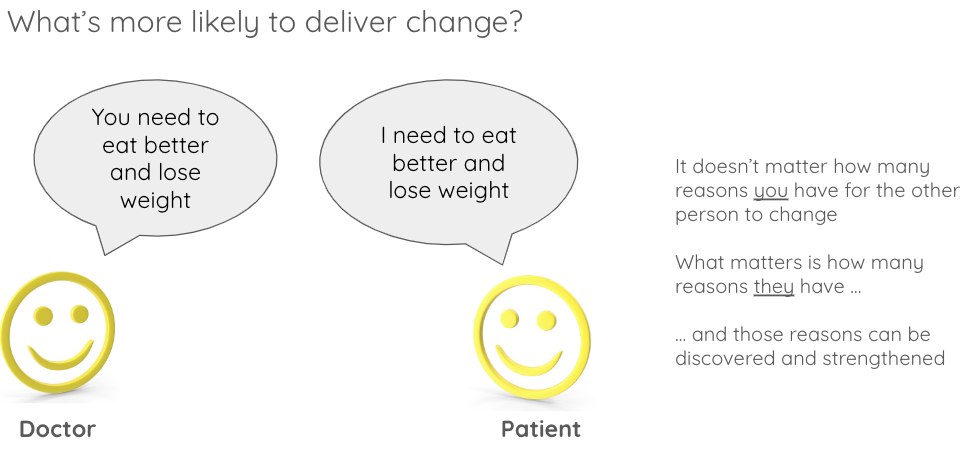
As mentioned in the intro, often the worst way to try and inspire change is to tell someone what to do. A predictable outcome is that all this does is to increases their resistance. The technical term for this is "reactance".
Reactance in psychology is an emotional reaction to pressure or persuasion that results in the strengthening or adoption of a contrary belief. Human beings would rather demonstrate their autonomy than do what someone else is telling them to do.
By assuming the role of "advisor" you'll take away control, overestimate readiness to change - and confront force with force, which rarely works
If you want to reduce resistance and have the potential to help the person to see lasting and meaningful change, the opposite approach is to emphasise personal choice and autonomy. To do that, you'll need to learn to employ empathic listening and practice the art of not jumping in with unasked for advice.
First, it's important to remember the goals of Motivational Interviewing:
Helping people decide whether or not they want to change. MI accelerates the decision.
Achieve 'intrinsic' motivation and opposed to 'extrinsic' (meaning that the desire to change comes from within the person as opposed to having it forced on them).
This represents a fundamental set of principals in MI and anyone can learn to do it.
In MI, you should be asking at least twice as many open-ended questions as closed questions. For the purpose of this article, I'm trusting that the reader appreciates the difference between open and closed questions. That said, it's not as easy to do when in a real-life conversation and takes some practice. A simple tip to help you, is to ensure that the environment you're creating for the discussion is optimised. For example:
This is a great way to show that you're listening and that you've noticed what is right with the person. This could be anything related to their values, achievements, strengths, and previous efforts. It reinforces what they already believe or desire, and has the power to help the other person realise what they want moving forward. Affirmations must be genuine and short, but are not the same as praise or compliment. Examples might include:
This is a core skill in motivational interviewing and could otherwise be described as empathic listening. It's a very active process and helps you check you’ve understood correctly. It happens in the form of reflective statements. It also helps the other person feel listened to and understood, and understand themselves better. Furthermore, it will keep them talking! However, it isn't easy and even experienced counsellors and coaches can find it challenging, and it requires practice and discipline. An MI competence for coaches is to offer twice as many reflections as questions. Reflective Listening statements sound like:
Offering a summary of what the other person has said helps them to hear what's come out of their own mouth. Again, it helps them to feel listened to, heard and understood, which is hugely important in them finding a positive outcome by the end of the conversation. You can also use a summary to illustrate progress to provide feedback and check understanding. If during the conversation you sense that it might be helpful for the person to change direction, they can also be used to pivot. A few key pointers here:
By following this simple method, you'll find it easier to resist the righting reflex (our natural human tendency to want to set things right), and to understand the person's motivation. This will empower them to make a decision and support their self-efficacy.
You might find that you notice a lot of what MI Practitioner's call "change talk". These are things the other person says which indicate an interest in or readiness to change their behaviour. Change talk usually predicts the likelihood of change happening and in MI, we use open questions to evoke and bring out change talk, affirmations and reflections to notice it, and, finally summaries to help develop or strengthen it.
Motivational Interviewing is a collaborative, person centred conversational style. It aims to help a person explore and resolve ambivalence about change. It doesn’t matter how many reasons you have for the other person to change, what matters is how many reasons they have, and their confidence about changing. Motivational interviewing may help to deliver better outcomes, improve relationships, and improve wellbeing. It's a learnable and deliberate practice, where feedback is key.
This article is an introduction, and, as you might imagine, there's a lot more to it than what I've been able to share here! If you're interested to explore further, I'd recommend the following book by William R Miller and Stephen Rollnick: Motivational Interviewing: Helping People Change and Grow.
If you’d like to discuss in more detail, please reach out to me at steve@encourager.co.uk.

Fractional HR, executive coaching and workforce transformation — designed for the Human + AI era.